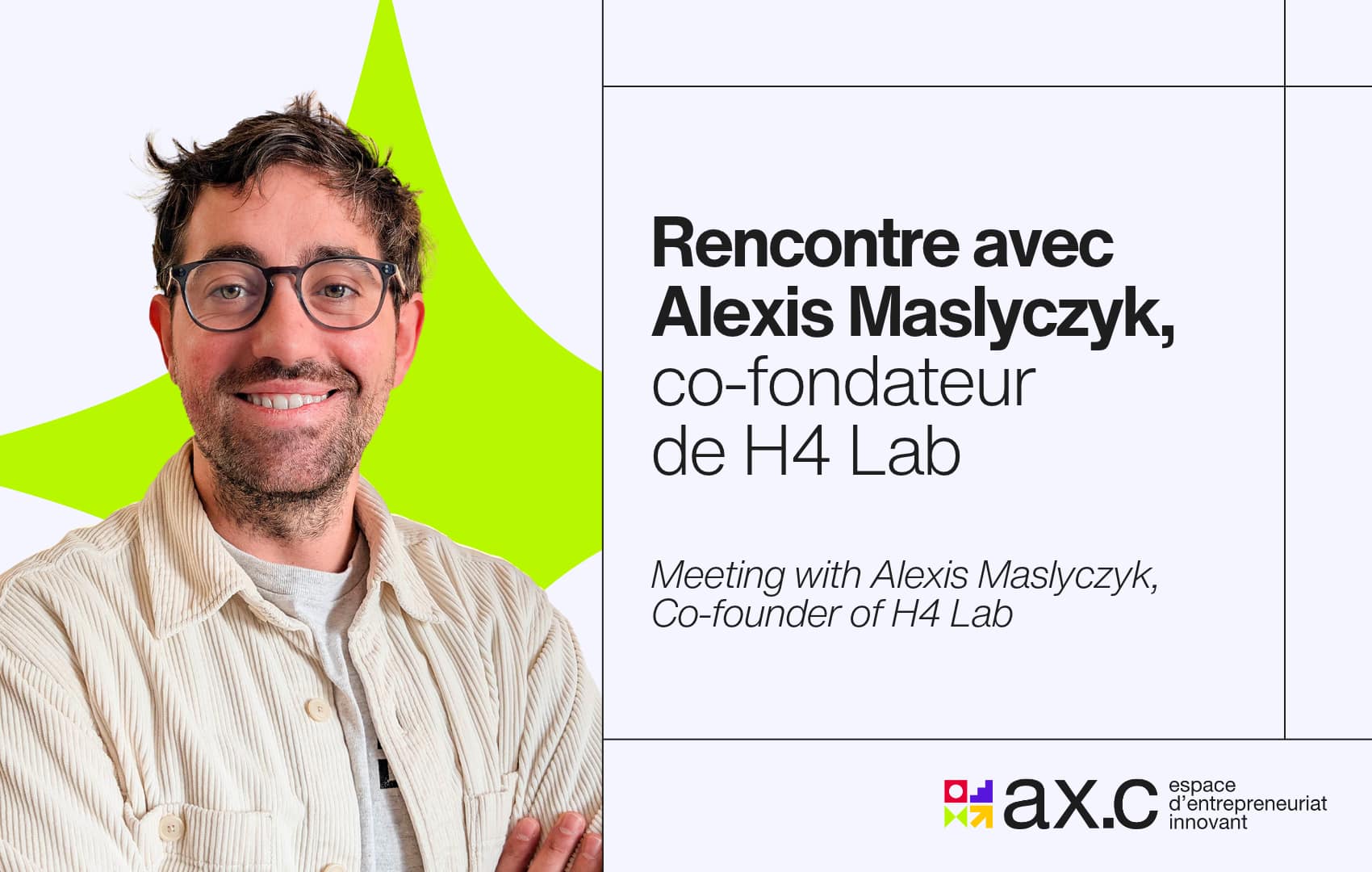
🎙️ Let’s go back a little: what was your journey before starting your business?
I studied electronics engineering in France. From the beginning, I knew I didn’t want to stay there. I had already travelled quite a bit, and I wanted to keep exploring the world after graduating.
I had the opportunity to pursue a dual degree and came to Montréal in 2014 to complete a research-based master’s degree in robotics. I worked on developing tactile sensors for robotic grippers. The idea was to give robots a sense of touch so they could manipulate objects and detect what they were holding.
I finished my master’s in 2017 and started working in the industry, particularly in the automotive sector, just as electric vehicles were gaining momentum.
During COVID, I felt like I needed a change. I was tired of spending my days staring at Excel spreadsheets. I came across an opportunity at a humanoid robotics research centre in the United States. I applied, and after a few months without hearing back, everything happened very quickly: an interview, a job offer, and a move to Florida.
I spent three years there and learned an incredible amount. That’s also where I started identifying gaps in the market. Humanoid robotics was still a relatively new field, and there was a real lack of electronic products designed specifically for these systems.
When I returned to Montréal, I already had several ideas in mind. My two co-founders, Chandra and Jean-Baptiste, and I had incorporated H4 back in 2018, without really knowing what we would do with it yet.
I started working as a supplier for my former employer, and we gradually began developing our own products. As humanoid robotics gained momentum, demand increased, our team grew, and H4 started to take off.
Did you always know you wanted to become an entrepreneur?
I think so.
I met Chandra, one of my co-founders, when we were studying at an IUT (University Institute of Technology) in France, right after high school. We were already building robots in student clubs and talking about starting a company together someday. That was over 15 years ago! Our paths eventually went in different directions. I moved to Montréal, and Chandra later joined me to pursue his PhD. We reconnected here and eventually started our company.
So yes, I think that was always part of the plan. And I’m happy to see that we’re still making it happen today.
When did you tell yourself, “I’m ready, I’m going for it”?
I don’t think there was one big turning point. I see entrepreneurship more as a marathon, with lots of small milestones along the way. But there was one particularly memorable moment...
We had developed an electronic design, and even though we weren’t entirely sure about it, we decided to publish it on GitHub to showcase our expertise. And then someone asked if they could buy it! We took the design off GitHub, had it manufactured, and it became the first product we ever sold.
That made us realize that what we were developing had real value, that there was a genuine need, and that people were willing to pay for our solutions. That’s when we thought: why not see how far we can take this?
I also think my industry experience played a big role. I had the opportunity to understand the market, see the challenges firsthand, and identify what was missing. That opened doors for us.
Where does the name H4 Lab come from?
Originally, we were working on an idea for a magnetic gripper. In electronics, the magnetic field is represented by the letter H.
We were looking for a name and a logo. At one point, we simply flipped the letter H, and it looked like a 4. That’s how we came up with H4, even though there are three of us co-founders!
We also wanted something simple that would be easy to pronounce in English.
Did you go through an incubator?
Yes, we joined Centech’s acceleration program when I returned to Montréal. But by that point, we were already starting to get our first customers and gain some traction. We knew our market well and had a pretty clear vision of what we wanted to achieve.
So it was difficult for us to spend time in training sessions when we already had products to develop and sell. We eventually decided to leave the program and focus our time on moving the company forward.
If you had to give another entrepreneur one piece of advice?
Find someone who shares your vision and interests, and who you can truly rely on. Entrepreneurship comes with a lot of ups and downs. Having a co-founder to share the responsibilities, stress, and mental load makes a huge difference.
It helps you keep moving forward, even when things get tough. I would have a really hard time imagining succeeding on my own.