Français
(News)
News
Portrait

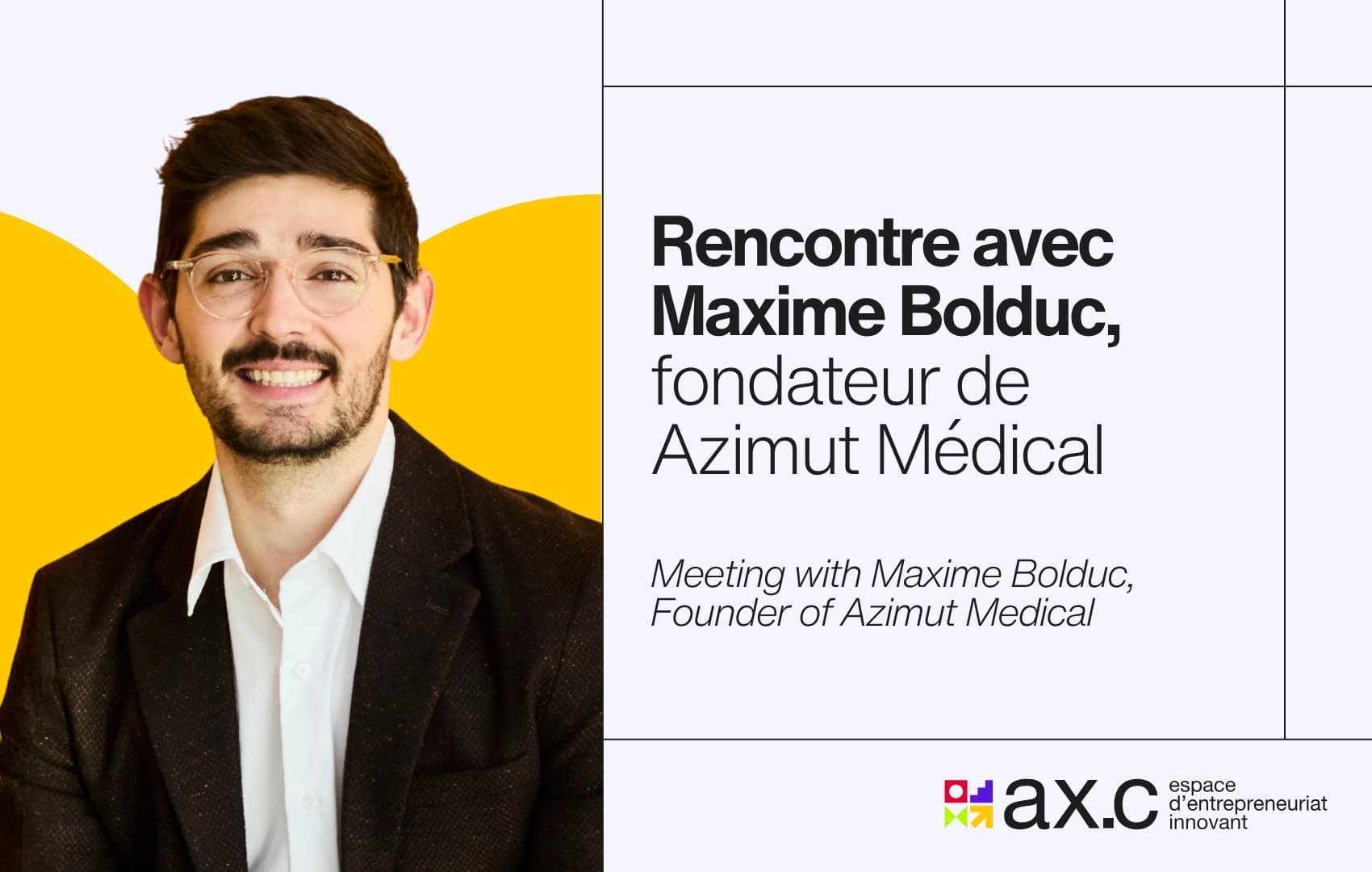
Portrait of an Entrepreneur: Maxime Bolduc

With Azimut, Maxime Bolduc is developing a technology with a clear ambition: to help older adults keep moving with greater confidence while reducing the risk of fall-related injuries.

The project began with a personal experience: his grandmother fractured her hip just as he was discovering entrepreneurship while studying mechanical engineering. A few years later, Azimut is developing a garment capable of detecting a fall and deploying an airbag around the hips.

In this interview, Maxime reflects on the journey since his first steps into entrepreneurship, as well as the reality behind being a founder: responsibility, uncertainty, the importance of staying close to users, and the human lessons that have shaped his journey.

Let's Introduce Yourself

My name is Maxime, but my friends usually call me Max. I founded my startup Azimut Medical because I wanted to improve people’s lives. As a child, I wanted to be an engineer and I was a huge fan of cars. My favourite meal is a steak on the barbecue, and if you ran into me on a Sunday, I’d probably be working on a personal project, like designing an espresso machine.

Entrepreneurial Journey

🎙️ Let’s go back a little: what was your journey before starting your business?

I did a bachelor’s degree in mechanical engineering. During my final semester, I took an entrepreneurship course that really opened my eyes to that possibility.

I had already completed several internships in the industry, including in aerospace and medtech, but I wasn’t necessarily thinking about starting a business. Around the same time, my grandmother fractured her hip, which gave me a very concrete problem to explore during that course.

After that, I launched the company and started a master’s degree in engineering, which I completed last year.

Did you always know you wanted to become an entrepreneur?

No. I had a hard time fitting into traditional moulds, and I spent a lot of time wondering what kind of work I wanted to do in the future. After taking that entrepreneurship course, this path felt pretty natural.

My grandfather was an entrepreneur, so maybe it skipped a generation! Both of my parents are bankers and tend to approach things from a risk-mitigation perspective. I went completely in the other direction.

When did you tell yourself, “I’m ready, I’m going for it”?

I was finishing my bachelor’s degree when COVID hit. There was already so much uncertainty that I thought: why not add a little more?

In that context, entrepreneurship didn’t really seem much more uncertain than anything else. I decided to take the leap and see where it would lead me.

Where does the name Azimut Medical come from?

There’s a French expression, « tous azimuts », which evokes all directions, but also the idea of exploration.

Our goal is to give people back their freedom of movement and independence, and reduce the fear of falling so they can start exploring again. That’s where the name comes from.

Did you go through an incubator? What did you get out of it?

Yes. Our project ranked in the top three in my entrepreneurship course, which at the time gave us direct access to Centech’s Acceleration program. I completed the program alongside my final semester and then continued with Propulsion and other programs.

When you have no previous experience in entrepreneurship, these programs allow you to learn a huge amount very quickly. But at some point, you have to move beyond theory, get into the real world, and adapt what you’ve learned to reality.

What’s the best advice you’ve ever received?

Stay close to your customers.

At the end of the day, a business is about selling a product that solves a problem people are willing to pay for. You can have an excellent solution, but if nobody wants to pay for it, you don’t have a business.

It can be difficult to hear, but talking to your customers early can save you from spending six months developing something they don’t want.

And if you had to give another entrepreneur one piece of advice?

In business, there aren’t just two or three ways to structure a deal. You can be much more creative than you think.

If one element is holding up an agreement, ask yourself why it absolutely needs to be part of it. There’s often another way to structure things and reach a win-win situation.

Building Azimut Medical

When did your idea become tangible?

When I started having employees under my responsibility, deploying our products in pilot projects, and working with organizations willing to pay to test them.

When other people start depending on what you’re building, it becomes very real.

If we look five years ahead, where do you see your startup?

I’d like us to be present in every Canadian province and in the United States, and maybe preparing for a launch in Europe.

What’s the next major step toward that vision?

The conclusion of our clinical trial will be extremely important in demonstrating the effectiveness of the device, but also its medico-economic impact.

At the same time, we’re launching our at-home testing program. We have around 500 people on our waiting list, and about 20 will take part in an initial phase with early adopters. We’re also starting our first sales in seniors’ residences.

What do you need most right now?

Funding, of course. We’ve just completed the first tranche of our investment round, and a second one will open soon.

But the best money is still customer money. So we also need to bring in more customers, better understand their environment, and continue refining our product based on their needs.

If you could meet one person who could make a real difference, who would it be?

Companies working in the aging sector, but also directors of seniors’ residences, long-term care centres or hospitals who want to shift current approaches toward greater prevention and would be open to introducing a device like ours.

Do you use your grandparents as models when developing the product?

Yes! My 102-year-old grandmother has a general idea of what we do. My other grandmother supports me 100%, but she’s also very critical of our products!

When I bring her garments or prototypes, she doesn’t hesitate to tell me exactly what she thinks. It’s not always pleasant to hear, but it’s constructive.

I’ve even invited her Scrabble friends for fitting sessions so we could collect their feedback.

You can’t develop a solution for a particular audience without talking to them. And not just one or ten people—you need to meet a lot of them in different contexts.

What kind of feedback do users give you about the product?

Often, it’s not at all what you expect. You can spend three weeks working on a detail nobody notices, while something as simple as the colour can become a deciding factor.

It forces you to understand what actually matters to the customer and set aside your own biases as a designer.

Behind the Entrepreneur

Looking back, what are you most proud of today?

Today, I’d say my learning journey and the person I’ve become. I think I’ve developed much more empathy for the people around me.

But what will really make me proud is having a tangible impact with our product. If our clinical trial shows that we can prevent serious injuries and reduce fall-related hospitalizations, that will have a real impact.

On the other hand, what has been the most challenging?

The responsibility. I’ve had moments when I knew that if I didn’t pull an all-nighter to deliver the product the next day, nobody else would.

There’s also the financial stress and the responsibility you have toward employees, partners, suppliers, and customers. Mentally, that can weigh heavily.

Is there a phrase or mantra that guides you?

My grandmother always tells me: “One day at a time.”

There will always be an endless amount of work. You have to be able to end the day by telling yourself: today, I did what I could. Yesterday was yesterday, tomorrow will be tomorrow. Today is what I can control.

Is there one person who has really made a difference in your journey?

There are far more than one. Probably around 20 people have influenced my journey in one way or another.

I think what matters is surrounding yourself with people who have qualities you’d like to develop yourself: people who will challenge you, but also people who are simply able to listen.

Has there been a connection or synergy at Ax.c that has had a tangible impact?

Yes. There are a lot of startups at Ax.c, and we share a lot of advice and contacts.

In my hallway, there’s Josephine Care, which also works in the aging sector. I’ve developed a great relationship with its founder. Our products are very complementary, and we operate in the same industry, so having them as a neighbour is very strategically relevant.

To wrap things up: what motivates you to get up in the morning?

Motivation isn’t linear. It comes and goes.

What always brings me back is the possibility of having a positive impact on people’s lives. I’m privileged to be able to use my skills to develop a product that I hope will genuinely change lives.

But there are also moments when you wonder whether you’re just being stubborn, whether it’s actually going to work. Nobody can answer those questions for you. You have to learn to keep moving forward with that uncertainty.

Finally, is there a message you’d like to share with the people reading this?

Entrepreneurship has made me realize just how valuable human connection is. If there’s one message I’d like to share, it would be to never forget that.

We’re entering an era where there are more and more digital intermediaries between people. We need to keep valuing genuine human interaction. To me, that’s also the beauty of entrepreneurship and doing business: creating meaningful human connections.

Discover Azimut

Suggested articles

View all news
Portrait of an Entrepreneur: Alexandre Clarizio
Portrait

Portrait of an Entrepreneur: Alexandre Clarizio

Portrait of an Entrepreneur: Nanette Sene
Portrait

Portrait of an Entrepreneur: Nanette Sene

Portrait of an Entrepreneur: François Daoust
Portrait

Portrait of an Entrepreneur: François Daoust

View all news

Your privacy is important to us. By using this site, you agree to data tracking as described in our Privacy Policy.

Necessary data

The tracking of certain data is required for the operation of the website and therefore cannot be deactivated: choice of language, consent and preference on data tracking, etc.

Mandatory
Optional data

In return, the tracking of certain data is optional and requires your consent: collect statistics on traffic, analyze visitors’ journeys to improve the functioning of the website, offer personalized offers, etc.