(Nouvelle)
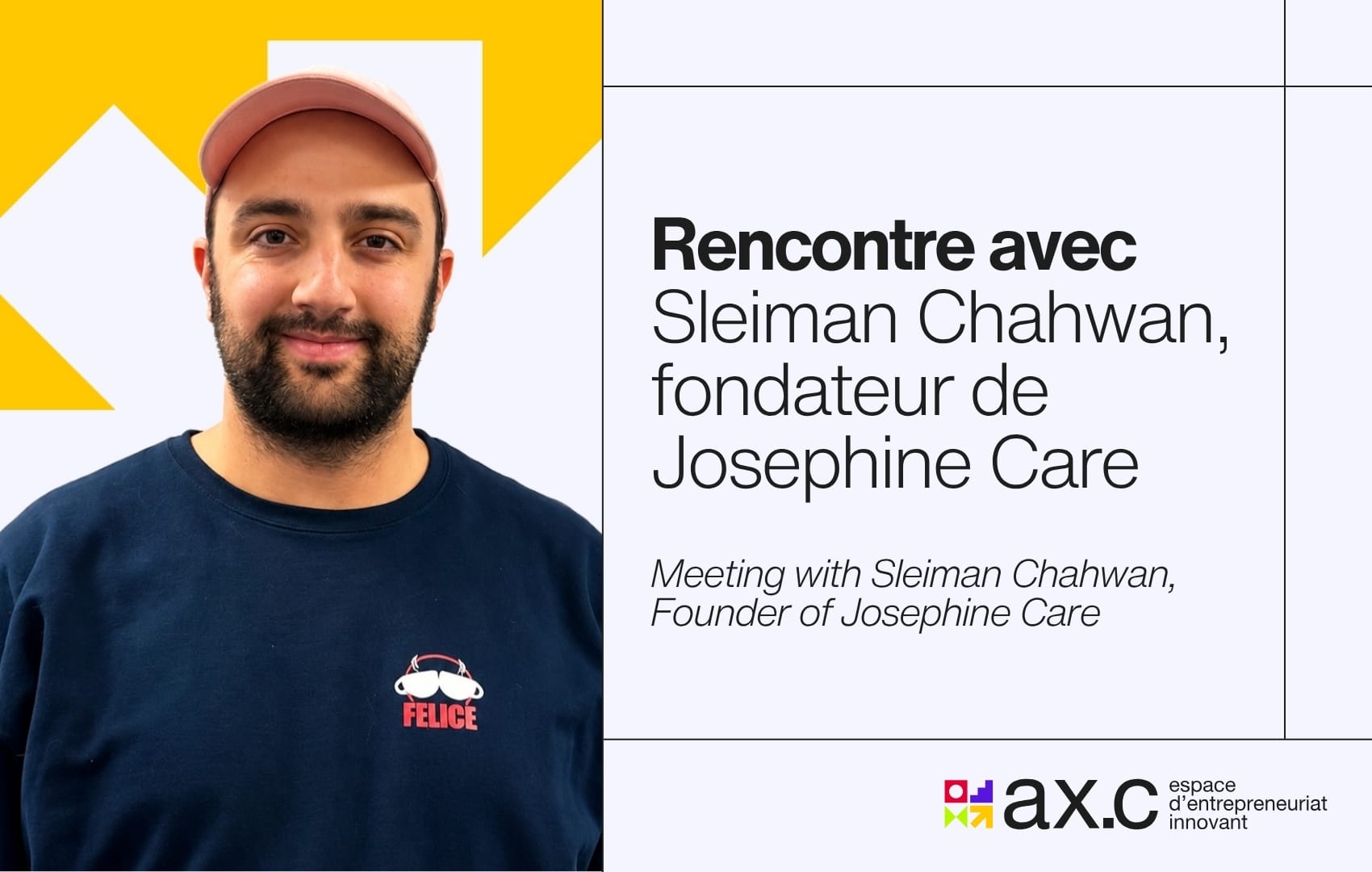
Portrait of an Entrepreneur: Sleiman Chahwan

In the startup world, some companies aim to optimize processes. Others seek to transform entire industries. And then there are those born from a deeply human need.
That is the case with Josephine Care, a Quebec-based startup founded by Sleiman Chahwan, which develops non-intrusive technologies to help seniors and at-risk populations live longer, more independently, and safely at home.
Behind the technology lies a personal story — that of a passionate entrepreneur, but also a grandson inspired by his grandmother Josephine, and a founder who deeply believes in the power of collaboration.
We spoke with him about his journey, the challenges of entrepreneurship, and the mission that drives him to keep pushing himself further every day.


🎙️ Let’s go back a bit: what was your background before launching your startup?
Before Josephine Care, I already had my own software development company. I was building software for startups and other businesses. I worked as an IT development consultant with a small team, and we created digital products.
Did you always know you wanted to become an entrepreneur?
Not at all. When I was younger, I was much more science-oriented. I was thinking more about a career in engineering or medicine.
The turning point came when I met my grandfather in Lebanon at the age of 14. He was a merchant, and he took me to the market with him. I watched him negotiate the price of tomatoes.
It fascinated me.
Back home, the listed price was the price you paid. There, I was seeing someone negotiate naturally. That moment is really what sparked my interest in business and entrepreneurship.
When did you tell yourself, “I’m ready, I’m doing this”?
It happened gradually. At first, I was mostly trying to solve a problem theoretically, almost like a side project. Then a friend I had shared the idea with told me: “My father would have needed something like this.”
That’s when something shifted.
I realized it might not just be a personal project, but something that could genuinely impact families. Then, when we landed our first $150,000 project in a residence in Nicolet, it became very real.
Did you go through an incubator? What did it bring you?
Yes, I joined Centech in 2024. Martin Enault brought me into the cohort three days before the program started. At first, I was simply looking for an incubator to help find early adopters.
It truly became a catalyst for us.
Centech allowed me to meet people, receive coaching, and most importantly, become part of a stimulating entrepreneurial environment.
What’s the best advice you were given when starting out?
The best advice is to listen to everyone, but ultimately listen to yourself. You can receive coaching and opinions from everywhere, but nobody understands your context better than you do.
Gut feeling remains extremely important.
And if you had to give advice to an entrepreneur?
I’d say: ask questions. In entrepreneurship, I’ve learned that if you ask a question, you might get an answer. If you never ask, you’re guaranteed to get nothing.
At worst, you’ll hear no. But sometimes, a simple yes can completely change your trajectory.

At what point did your idea become tangible?
The first real moment was when people started reacting emotionally to the idea. When someone told me, “My father would have needed this,” I understood we were touching something real.
Then, when we received our first major funding for a concrete project, I truly felt it had become tangible. Seeing people trust our technology in a real living environment was powerful.
If we project ourselves five years into the future, where do you see Josephine Care?
I hope we’ll be across Canada, with thousands of installations, helping as many families as possible.
Seniors are the population most at risk, but our technology can also help other groups: people living with autism, people with reduced mobility, or individuals who want to live alone more safely.
What’s the next major step to get there?
The next step is continuing to grow the company and generate more revenue. Today, like many startups, we still rely heavily on fundraising and grants. The goal is to invest more into the technology and continue developing better solutions.
What do you need most right now?
Obviously, funding remains important. But more than anything, we need collaboration and awareness.
Our biggest competitor is not another technology. It’s inaction.
Often, people contact us after a fall or a crisis. What we want is to intervene before that happens. The challenge is that many seniors don’t want to acknowledge their loss of autonomy. So we need to make the conversation easier and make these technologies more accessible and less intrusive.
If you could meet one person who could change everything?
I’d like to meet policymakers who genuinely want to move things forward for seniors. There’s a huge economic impact in prevention. A technology like ours can prevent many costs related to emergencies and hospitalizations.
But it requires real willingness to implement these kinds of solutions on a larger scale.

Looking back, what are you most proud of today?
My greatest pride is having made the choices that brought me where I am today. Building a startup is incredibly difficult. You live with uncertainty constantly.
I literally know the death date of my company by looking at my cash flow. But despite that, I’m fortunate to work every day on something meaningful, and that’s an immense privilege.
And on the other hand, what has been the most challenging?
Human relationships. Getting the people around you to accept this lifestyle isn’t always easy.
My mother still sends me job offers regularly. Before, it annoyed me — now I find it pretty funny. Over time, I’ve learned to accept that not everyone will understand us.
Is there a phrase or mantra that guides you?
Yes, I have two.
The first one is: “F*** relax.”
When I’m stressed or have to make a decision in the heat of the moment, I repeat that to myself.
The second is: “How good you are? How good you want to be?”
At one point in my career, I worked in New York, and it forced me to question myself and constantly strive to improve.
Is there someone who made a real difference in your journey?
Yes, several people. Some simply chose to give me a chance at the right moment.
I’m thinking especially of Martin Enault, but also Maxime Bolduc from Azimut Médical, who took the time to share a tremendous amount of information with me after a pitch at Centech.
That kind of generosity can truly change an entrepreneurial journey.
If you had to explain what you do to your grandmother?
Josephine was actually my grandmother’s name.
If she were still here today, I’d simply tell her that I built something to help keep her safe and allow us to keep her with us longer.
Was there a meeting or synergy at Ax.c that had a concrete impact?
Yes, definitely. My meeting with Maxime Bolduc from Azimut Médical had a huge impact. But more broadly, the entire energy at Ax.c plays an important role.
Seeing other entrepreneurs work, evolve, and grow every day is incredibly motivating.
It’s an energy you wouldn’t find quite the same way elsewhere.
You talk a lot about collaboration. Why is it so important to you?
Because collaboration is at the core of Josephine Care’s philosophy. Our technology is designed to work with different partners and stakeholders in the field.
That’s also what motivated us to organize the High Tech Summit — to bring together startups, researchers, decision-makers, and organizations around issues related to aging and technology. The goal is to create connections and encourage meaningful exchanges.
Finally: what motivates you to get up in the morning?
At the very beginning, this project was born because of my niece Léa, who lives with a severe disability. I was trying to develop technology for her. Even though it didn’t work out as planned, that experience completely changed the way I see things.
Today, what motivates me is being able to transform that energy into concrete impact for other vulnerable people.
Even during difficult moments, I feel incredibly fortunate to work on something meaningful.